Making a Difference

This year, the superintendent from District 2, Bonnie Laboy, has initiated a Middle School Leadership Council.  Representatives from the student councils from middle schools across District 2 meet monthly to plan for leadership initiatives in their schools.

Last week, I was privileged to attend this monthly meeting of middle school students. I was so impressed by the thoughtfulness of this group of adolescents.  Students from each school were concerned about issues of diversity and respect in their school communities and expressed a strong desire for their communities to be more accepting of difference.  They were brainstorming ways that they could advise policy for District 2 middle schools on achieving greater respect and inclusiveness in schools.  They realized that the primary way to achieve this is through educating others — students and teachers — about different cultures and groups within a school community.  Ideas they generated include building in a requirement for schools to teach students about others through advisory and the curriculum and to have clubs that work towards creating safe spaces such as GSAs.  In their brainstorming, they were required to think about stakeholders, resources needed, and impediments to the success of the initiative. (Grown ups,sadly, were identified as one of these impediments.)

It is not surprising that adolescents are focused on issues of diversity and acceptance.  Adolescence is a time when children are figuring out who they are and how they fit into different communities.  They are starting to have serious crushes and begin to try out “dating.”  Cliques and friendships are constantly forming and re-forming as our young people learn to navigate complex social situations.

Since elementary school, students have tried out language of difference to situate themselves in a community.  Calling something “gay” or commenting on race, skin color, home language, or religion are all ways that children have been aligning themselves in communities for generations.  My third graders in the late 80s (yes, some of you could have had me as your third grade teacher) tried out this language and third graders today continue to try out this language.

There are differences in the experience of students around difference between past generations and children today. Today, they have powerful computers in their pockets that allow them to instantly comment on others (for better or worse.) We also live in a society which is, fortunately, much more open to acknowledging and accepting difference. Whether it is in the books they read, sitcoms they watch (stream), music they listen to, our children today are steeped in ideas of acceptance for difference. #marriageequality #blacklivesmatter #welcomerefugees  Even the political discourse to which they are exposed this election cycle highlights the importance of respect for difference (even if it is a result of learning from poor examples).

Our children are aware. They know what is going on around them. They value justice and are empowered to work towards equality and fairness.  I am really proud to work and learn alongside of them and to support them in their efforts to make a difference in the world.

  • Our initial support of students has been to give them space to create a GSA in our school.  Not many children consistently show up for this student-led group. Among those that do, however, are students who are very vocal as well as students who sit quietly and observe.
  • We have also supported students by arranging for a student-led panel from the Harvey Milk School. These students are learning to share about their experiences in expressing their identities. Through this work, our students gain empathy for the experience of others.
  • We are also looking more closely at our curriculum. Students have pointed out that we need to more clearly address the experiences of those who have been oppressed in society.  While I have been resistant to relegating Black History to one month of the school year, talking with the students has helped me rethink my position. I am working with staff members to develop initiatives that foster conversation and learning about others. Stay tuned for upcoming details.
 

Matching Books to Readers

One of the tasks of the SLT is to document and communicate our curriculum and how we teach to parents. Last year we worked on a math document that highlights our approach to mathematics education and previews what students learn in each grade. This year, we are tackling our ELA curriculum.  There are many components to these documents. We include big goals for the content area, standards, and other supporting documents. In ELA, a key piece to understand is how we help students choose appropriate books.

When we go to the bookstore or library, we don’t find books sorted by “levels.” Instead, we choose books based on interest and then usually read a bit of it to see if it “fits” our reading preferences and profiles.  Sometimes we read books that we can read fluently with deep comprehension and enjoyment.  Reading these books is relatively fast and is not very demanding. They help us build stamina and fluency. Sometimes we read books that are a bit more challenging. These books require more concentration and pauses as we stop to synthesize meaning. We may have to work a little harder to understand new sentence structures or words used in new ways.  Then there are the books we read that challenge us in structure, content, craft and vocabulary.  They take longer to read but have their own rewards, whether it is a feeling of accomplishment as we learn new content or ways of viewing the world or a sense of satisfaction in having persevered through something that stretches our skills.

At each step in our reading development, we encounter texts that build our reading skills in different ways.  From wordless picture books to Dostoyevsky novels and books about complex phenomena in the sciences, readers integrate visual and semantic skills as well as knowledge of the world.

Irene Fountas and Gay Su Pinnell, experts in literacy learning, mapped this continuum of learning to different types of texts.  These text types have been labeled with letters of the alphabet and provide teachers with a metric to plan for reading instruction. This instruction includes what skills readers are ready to learn next and what books most appropriately support that learning. We don’t share this with children because we prefer to help them learn to independently select books that they enjoy and provide an appropriate challenge.  We want students to select from a range of genres — realistic fiction, fantasy, science fiction, informational texts, poetry, etc.

As teachers, we recognize that growth in reading can be broken into 5 developmental bands from children who are just beginning to engage in their reading lives to young adults who read a range of texts with deep understanding and enjoyment.

Emergent readers are just beginning to understand that words are made of sounds, that letters represent these sounds and combine to create words that have meaning, that each word is defined by space on the page, and that we typically read from left to right and top to bottom in English. Readers at this stage typically use their fingers to point to individual words as they train their eyes to sweep across the page.  Books at this level have few words, repeating patterns, and usually only one line. Images in these books closely match the text so that readers can use the pictures to help them figure out the words.  Have You Seen My Cat? by Eric Carle is an example of an emergent book.

Early readers are those who have figured out for the most part how texts work.  They can read high frequency words with automaticity and use their letter-sound knowledge to figure out new words while reading.  Early readers are also using knowledge of how words and books work, together with their knowledge of the world, to monitor their comprehension.  They read less complex texts fluently and use punctuation to help with phrasing.  They integrate meaning, syntax and visual aspects of print as they read longer texts.  Books at these levels have multiple lines on a page, introduce dialogue and more varied vocabulary, and may have sentences that carry across pages.  Students typically learn through these books in late kindergarten through the beginning of second grade. Llama, Llama Misses Mama by Anne Dewdney is an example of a book at the beginning of this band. Curious George by Margaret Rey is the type of text that children can begin to read at the end of this band.  

Transitional readers have solidified their skills to the point that they are able to read silently.  They know have a large bank of high frequency words and continuously apply multiple reading strategies to solve problems while reading.  Books in this band have fewer illustrations and readers use those illustrations enhance understanding rather than rely on them to construct meaning. They are learning to sustain reading over longer texts, including early chapter books.  Students in this band, usually in second and third grades, enjoy reading books in a favored series. You can stretch these readers by encouraging them to read a variety of genres and informational texts. A Kiss for Little Bear by Elsa Holmelund Minarik is an example of a book at the beginning of this band. By the end of this band, readers have grown to read books like the Magic Tree House series.

Self-extending readers are reading orally with increasing fluency but often prefer to read silently.  The books they read tend to be longer and require stamina to read over several days.  They read fiction and nonfiction for enjoyment and to build background knowledge and apply this knowledge as they dig more deeply into books.  As they read, students at this level apply multiple sources of information smoothly, analyze words in flexible ways, and continuously build higher level skills.  This is an exciting stage of reading as children become absorbed in their reading, identifying with characters and make connections across texts that they have read. Typically, students enter this level of fluency in third grade.  Often, more sophisticated picture books are categorized at this level; Sylvester and the Magic Pebble by William Steig is one example. Ramona books by Beverly Cleary are examples of chapter books at the beginning of this band. As students finish fourth grade, they are getting ready to move on to the next level. They enjoy titles such as Shiloh by Phyllis Reynolds Naylor.

By fifth grade, students should be entering the advanced reader stage.  They read silently, effectively understand how words work and go beyond the text to interpret and deeply understand the texts they are reading.  They can read for extended periods of time. Most exciting, they begin to read to better understand the world from philosophical, ethical and social perspectives.  By middle school, readers begin to read much like adults do as they tackle increasingly complex texts.  Books in this band include Roald Dahl’s Matilda and Seymour Simon’s Galaxies up to title such as Lois Lowry’s The Giver and J R R Tolkien’s The Hobbit.

.  


School Culture

IMG_2349.JPGShared values help to keep a community working well.  This year, we have been working with our students to articulate ways that we want our school community to work. Students in each class came up with 3 or 4 statements about what they felt were important attributes for our school community.  These statements have been posted in the glass by the elevators for about a month.  
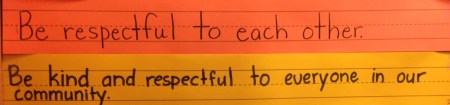
Kids shouldn’t surprise me anymore, but they always do.  I was surprised that there was so much overlap among the statements across the grades.  Kindergarteners through eighth graders all agreed that school is a place where we work to have respect for each other and we act safely because we value and have responsibility for our community. We have winnowed down the list students generated to create a set of community guidelines. 

Chargers Community Agreements: 

  • Walk quietly in hallways and stairs. 
  • Make thoughtful and safe choices. 
  • Be respectful to all. 
  • Contribute to the community.

We will be sharing these four rules with students this week and they will be posted in the hallways and other public spaces.  These are not new rules. We work every day to help the children work towards these goals.  Sometimes our community is more successful at following them than others.  That is to be expected and helping children to more consistently enact these rules is a huge amount of the work of public schooling. 

The goal of public education is not just to teach academics. It also includes teaching children to be citizens in a democracy and to learn to work with people who are different from them.  “Public schools are not merely schools for the public, but schools of publicness: institutions where we learn what it means to be a public and start down the road toward common national and civic identity” (Benjamin Barber, as cited in Why Public Education Must be Preserved.)  In public schools, we learn to be part of the public.  

We work to help all children achieve social, community goals through multiple ways. We strive to use personnel resources so that every child gets what s/he needs in the school community in terms of social learning in the same way that we structure for differentiated academic learning.  That means that the struggling child and the child who is more sophisticated in social skills are both supported. To achieve these goals:

  • I work with the PTA to be able to allocate the bulk of our school budget to staffing.  The generous support of families through the annual appeal, the auction, the Winter Carnival and other fund-raising events, allows me to hire staff to provide a range of supports to our students. For example, the PTA has funded 2 teaching assistants this year for our at capacity second grade classes.  
  • We have highly skilled paraprofessionals work alongside teachers in classes that are mandated to have additional support. 
  • Our guidance team, Rachel Goodman and Alisha Bennett, along with our Middle School Dean Mary Valentine, and outside consultants work in classrooms, with individual students, and to provide additional support to teachers on how to foster dialogue, help students reflect on their actions, and to make wise, safe choices.  
  • We infuse social emotional learning in to the classrooms throughout the year. In each grade, teachers engage with students in structured curricula on social-emotional learning. We also highlight special events throughout the year that focus on community and respect. February 9 through 12 is celebrated in New York City as Respect for All Week. This year, teachers will be working with the students on our rules around respect and safety. We will also be having a “door decorating contest” in which classes decorate class doors around themes of respect, kindness and justice.  This activity will allow students to engage in conversations around our rules and how we are members of a larger community.  
  • We follow NYC guidelines around behavioral consequences. The NYCDOE discipline code provides guidance to schools and families around protocols for disciplinary consequences.  In murky or challenging situations, I also have a tremendous, behind-the-scenes support network.  District 2 Superintendent Bonnie Laboy and Family Advocate Jennifer Greenblatt along with DOE special education and school climate experts help our faculty help our students. 

We have these supports in place because we know that all children are works in progress. While some children are more adept at self-regulation, they observe others who struggle with self-regulation and skills around expressing feelings and navigating social situations.  Our goal is to have a school where all children feel safe and valued.  This is a big task and it requires school, families and children to work together.  I am honored to work in a community that has such a shared vision of equity and respect.  In return, I work to make sure that parental feedback is valued and listened to.  In the end, we all share a commitment to public education and the success of our children. 

 IMG_2352.JPG

Parenting Resources

IMG_1254One of the greatest joys of parenting is watching your child grow up to have confidence and to become successful in multiple ways.  (#proudmama)

That road is not always easy.  I have read my share of parenting books. And I have received a lot of great tips from watching and talking with parents of the children in my classes.  One year, I had a dad share with me that his guiding principle was to establish a relationship with his young child that would endure adolescence.  He knew that open conversations were key to helping his child navigate that tricky time.  Other parents were models of clarity around expectations, of accepting their child’s idiosyncrasies and recognizing that children are works in progress, or in identifying and nurturing their children’s passions. I continue to learn from you all.

This fall, I started seeing posters around the city advertising a website geared to helping families help children navigate learning differences. Intrigued, I decided to pay the website a visit.  Understood.org seems to have a good board of advisors and a wide range of resources to help parents help children with organization and academic skills. Check it out and let me know what you think.

Another website I have found that seems to have some good advice to parents is run by a clinical psychologist from Columbia University. Aha Parenting  provides coaching and tips to develop positive relationships with our children.

There are oodles of other resources. These are two that I have stumbled across. I will keep adding to this list as I learn of more.  Please feel free to share any sites you use. I have left comments enabled for this post.

Grouping in Math

In December, Ariel and Dawn hosted an information session for parents on grouping in math.  This is a topic that our staff has researched and debated for the past couple of years.  A number of us have been taking an on-line course with Professor Jo Boaler through Stanford University on the most current research on mathematics teaching.  As a staff, we have also read Carol Dweck’s book, Mindset, which is about the role that one’s perceptions of intelligence can influence learning in surprising ways.

Students’ academic success may be influenced not only by their actual ability, but also by their beliefs about their intelligence. Studies have found that students enter a classroom with one of two distinct conceptions of their intellectual ability: some students believe their intelligence is expandable (growth mindset), while others believe their intelligence is a fixed trait (fixed mindset). A review of the research suggests that students with growth mindsets outperform their classmates who hold fixed mindsets. In addition, the adoption of a growth mindset may decrease or even close achievement gaps. —Christie Blazer

As a result of this study, we have refined our understanding of the implications of grouping in mathematics and have reaffirmed our commitment to heterogenous mathematics instruction. Jo Boaler talks about the implications of grouping and the role of mindset in this video clip.  (You can search youtube for more videos by Professor Boaler on this topic. These video clips are part of the course of study in which the teachers and I are participating.) In addition to Dr. Boaler’s work, we have found several other important research studies on this topic.

Carrol Burris from Southside High School in New York, with Columbia professors Jay Heubert and Hank Levin, conducted a study of a detracking innovation in mathematics. They found that ALL Students from detracked classes (including students across the achievement range) benefitted from heterogenous classes.  Their pass rates were significantly higher, they passed exams a year earlier than the average student in New York State, they had higher scores on various achievement tests, and they developed growth-mindsets.

Research has also shown that tracking has negative impacts on high and low achieving students. High achieving students feel pressure to always get the correct answer, often feel that classes are too fast and students don’t want to admit they don’t understand something.  If students need to grapple with a problem, they can feel that they are not “smart.” As a result, students begin to dread or hate math classes. Lower achieving students are also negatively impacted by tracked classes.  In lower tracked classes, students  are given low level work and therefore fail to achieve at standard level.  Because they know they are labeled as low-achieving, students give up. We don’t want these outcomes for any of our students.

Rather than sorting students into math tracks, we offer an accessible curriculum that provides challenge for all learners. Our teachers use heterogenous (mixed) groups most of the time, with some small groups being taught in homogenous groups. Heterogeneous groupings allow for diverse perspectives, which lead to richer conversations and achievement of high standards for all students. As an added bonus, accessible structures lead to greater racial/socioeconomic equities and the development of respect among classmates. 


Features of accessible curriculum at 276 include tiered tasks in which teachers pose problems that have multiple levels of challenge embedded in them, small group instruction and open-ended tasks.

So how does this impact our scheduling and programming? We continue to provide and refine our program in grades K through 8. This program teaches big mathematical ideas through context rich problems, games, and discussion.  We continue to offer Algebra 1 in 8th grade which culminates in a Regents exam.  Students are selected for Algebra 1 through consultation with students and parents as well as an assessment of mathematical work habits, confidence and skill as evidence in state test scores, math grades, and teacher assessments. 

A more detailed explanation of our math curriculum, a summary of Common Core Learning Standards in mathematics, the powerpoint that Ariel and Dawn presented to parents, and other math resources, can be found on our school website.

Click to access april_v09-p.pdf

Resources

Blazer, C. (2011). How Students’ Beliefs about their Intelligence Influence their Academic Performance. Information Capsule Vol 1012: Miami.

Boaler, J. (2016). Mathematical Mindsets: Unleashing Students’ Potential Through Creative Math, Inspiring Messages and Innovative Teaching. Jossey-Bass: San Francisco.

Boaler, J. (2009) What’s Math Got To Do With It? How Parents and Teachers Can Help Children Learn to Love Their Least Favorite Subject. Penguin: New York.

Burris, C.C., J.P. Heubert and H.M. Levin (2006), Accelerating Mathematics Achievement Using Heterogeneous Grouping. American Educational Research Journal, Vol. 43, No. 1, pp. 105-136.

Dweck, Carol S. (2007).  Mindset:  The new psychology of success.  New York, NY:  Random House.

http://www.mindsetworks.com

https://www.youcubed.org/parents/

Book Clubs

Harry Potter.  Percy Jackson.   Fantasy books are highly enticing for young readers.  But beyond current pop culture titles there are a lot more great fantasy titles for young readers. A Wrinkle in Time by Madeleine L’Engle, The Golden Compass by Phillip Pullman, and Catwings by Ursula Leguin are just a few of classic titles that our fifth graders have been enjoying in a new unit in which they are reading and discussing fantasy books in book clubs.

There are many reasons for having book clubs in school. Book  clubs give students the opportunity to study a genre of text in depth and read books at a range of readability levels. An added plus is that the books in book clubs also tend to be more challenging than kids can read totally on their own.   In book clubs, students are reading the same book or  a book in a series as a group.  This gives them the opportunity to talk to each other about their books, thus deepening comprehension.  This conversation also allows students to orally rehearse writing in response to reading — a key test taking skill.   Because books in book clubs are selected to be  engaging for students, book clubs also allow students to increase their reading stamina.

Fifth graders are in book clubs right now.  Fourth graders have just finished reading social issues in book clubs and are getting ready to dive in to historical fiction. Students read dystopia  novels in grade 6 and look at how film makers depict young adult books in grade 7. Book clubs are powerful venues for improving reading skills and for building a culture that values books.

If you haven’t read young adult literature in a while, sneak your child’s books after they go to bed at night.  Pick up the novel that she or he is  reading and enjoy it.  Then, take the opportunity to talk to your child about that book.  Building habits of appreciating books together sets a stage for life long conversations with your child.


School Data Reports

Each year, our students take state tests in ELA (reading and writing) and math.  There is a lot of news about these tests and about the level of difficulty of the questions. If you are interested in learning more about last year’s tests, this link provides you with sample questions from the tests along with an explanation of the answers. The tests change yearly, so these will not necessarily be representative of next year’s test questions. 

Overall, our students performed well on last year’s tests.  Our school has been recognized as a “Reward School” for the 2015-2016 school year. We are one of 361 schools in New York State (including 24 charter schools) that had the highest achievement in the state without significant gaps in student achievement between subgroups.  While we take test results with a grain of skepticism, we are gratified to see that our students were well prepared for the tests.  

This week, the NYC Department of Education released two new documents.  The School Quality Snapshot and School Quality Guide summarize state test, school survey, and Quality Review data. We have been looking at test data in multiple formats to understand it.  We have compared our test results year to year (how do third graders do over years as well as tracking how cohorts of students score on these tests from grade to grade.)  

We also look at other schools in the city to see how we are doing. We face a couple challenges in doing this.  Often, we need to try to disaggregate data for our K-8 school to see how we are doing compared to K-5 and 6-8 schools. We also have to remember that our middle school is limited unscreened which means that we do not look at test scores or grades in admitting students to our program. Often, when we compare ourselves to other schools, they are screened — only taking students who score high 3s and 4s on state tests. 

This data shows that we need to work on helping students improved on the State Math tests (some of this data might be skewed by the students who are taking the Algebra 1 Regents test).  We are making considerable efforts towards helping students attain higher achievement in mathematics.  We are fortunate to have Ariel Dlugasch as a full time math coach this year. She is coaching teachers on improving their mathematics instruction.  She is also setting us up with a variety of mathematics PD.  Teachers are studying mathematics pedagogy at City College through the MiTC program and participating in study groups with Metamorphosis, a math education think tank. 

The data shows that we do well in helping students improve performance on their State ELA tests. But we also want to make sure we are improving our scores there as well.  Teachers are focused this year on enhancing the clarity of their instruction so that students are better able to independently apply the skills they are learning to different situations.   We are supporting teachers in this effort by sending them to professional learning opportunities off site and by having them work with consultants on site.  

We also continue to support teachers and students through our work with the Teachers College Inclusive Classrooms Project.  Staff developers from this organization help us to think through the use of learning progressions, articulating how skills build on each other. Teachers are using this work to understand student strengths and to plan for teaching high leverage skills — those skills that allow learners to learn efficiently. Examples of high leverage skills include understanding how the different models students are learning in math allow them to deeply understand and apply commutative and associative properties — key understandings and skills in solving algebraic problems.  Another example is to learn how main idea and theme are linked.  If I can retell the story and identify the main idea, then I can more easily identify the theme and support my reasoning with evidence from the text.  

Recently, Deputy Chancellor Phil Weinberg visited our school.  He noticed the impact of all the professional learning in which our staff engaged. In a follow up, he wrote me that he noticed that we are “cultivating a nurturing learning community, one that has an understanding of the responsibility educators must embrace to work hard in service of student learning.

The consistency and rigor of the instruction in the classrooms we visited was impressive. At every turn, students were deeply engaged in learning. I was particularly struck by the way students were learning with and from each other. Teachers were noticeably pushing young people to think for themselves as well as to think out loud with each other; to me, this is a clear result of the supportive learning community you and your dedicated staff are building. I was also impressed by your own knowledge of the promising instructional practices as well as the challenges facing every single educator in your building.”

Terrorist Attacks in Paris

The news from Paris on Friday afternoon was shocking and saddening.  We have many families at our school who are French or who have close ties to people living in France.  Our thoughts are with these families and with the French people.  


At the same time, we have families and staff in our school who are Muslim.  The Muslim community around the world is suffering tremendously.  The refugee crises in Europe and Southeast Asia are visible stories of the trauma that Muslim families face daily.  Our thoughts are with them as well. 


I can’t pretend to understand all the reasons why young people become radicalized.  Their paths towards violence are complicated and diverse and lead to tragic results.  My job as an educator is to help our children understand events and to help guide them to choices that make the world a better place.  My job as a school leader is to make sure that our school is a safe place for all children. 


This means that we want to make sure that children are talking about events in a safe and respectful way and that they are viewing media coverage with a critical eye.  It also means that we are guiding children away from the conclusion that all Muslims are terrorists.  We want to make sure that our students are supportive and compassionate towards all their classmates.   


How we handle this conversation with children is critical in helping them understand world events and how our own community responds to these events.    


On Monday, many children will be talking about this event.  They will have seen it on the news, heard parents talk about it, or have heard about it from other children on the playground.  Teachers will be leading appropriate conversations about the events during the next week.  Early grade teachers (K-2) will be listening in to children’s conversations before collaboratively planning how they will facilitate conversations at school.  


Rebecca Haverstick, one of our third grade teachers, sent me an email late last night reflecting on how she will facilitate a conversation with the children in her class about the events in Paris.  She started me on a list of resources (below) that can help parents talk with their children about the terror attacks in Paris. We will be adding to this resource list as we vet additional resources.  


Hand in Hand Parenting starts their post on the topic with the following story about Mr. Rogers. 

“As with many tragedies that are covered extensively in the media, children who hear about them may be confused or scared. Fred Rogers of Mister Rogers’ Neighborhood once shared a thoughtful approach for comforting children and instilling a sense of hope in them in the face of such incomprehensible events:


‘When I was a boy and I would see scary things in the news, my mother would say to me, “Look for the helpers. You will always find people who are helping.” To this day, especially in times of “disaster,” I remember my mother’s words and I am always comforted by realizing that there are still so many helpers – so many caring people in this world.’ — Fred Rogers” 


Resources, listed below, all share similar guidelines for talking about violence and traumatic events with children.  This list will guide conversations in classrooms. The guidelines include:


• Find out what kids already know. 

• Correct inaccurate information. 

• Encourage kids to ask questions. 

• Assure them that grown-ups are working to keep everyone safe. 


Older students will be discussing the complex nature of the good v evil, how injustice can lead to violence, and what actions we can take as individuals and a community to make a difference in the world. 


If you have any concerns about how this will be handled or if your child has been personally impacted, please contact your child’s teacher. You can also reach out to Rachel Goodman or Alisha Bennett, our guidance counselors. 


Resources: 

PBS guidelines to help parents talk with children about news events.
National Child Traumatic Stress Network  resources for helping children cope with terrorism
Hand in hand parenting a website with ideas around parenting
News-o-Matic an online news source for children. They share information on how to talk to children about scary and troubling news events.
Child Mind Institute provided information to Time Magazine for a piece on helping children cope with news of the Paris attacks. Read on time.com:  How to Talk to Your Kids About the Attacks in Paris.  The Child Mind Institute also has resources on their website coaching parents on how to discuss the news with children including tips on talking to children about frightening events and a guide for parents and teachers to help children cope with traumatic events. 

Talking About Race

Our on-site PD on Election Day created a good deal of emotion and conversation.  We had three facilitators from Border Crossers come and lead us in thinking about how people of color experience life in America. Those of us who are white are largely unaware of the daily challenges faced by our colleagues, students, family members and parents who are Black, Asian, Arab and Hispanic.  Thinking about this is deeply uncomfortable for us as privileged White members of society. If we really want to create an inclusive and just school community, and by extension, contribute to the justness of our wider society, then we need to sit with that discomfort.  Peggy McIntosh wrote about White Privilege a long time ago (1990!). Her essay is still important reading.


I am confident that teachers on our staff do not ever intend to be hurtful towards students in terms of race (or for any reason, but right now I am referring to race).  I know I don’t. But I also know that my skin color alone has allowed me to grow up so that I am largely oblivious to how my actions are perceived.  I was cleaning out my bookshelves and this weekend rediscovered a book by a White mother who raised her Black daughter in the south.  In this book, the author, Sharon Rush, a civil rights lawyer dedicated to jusice, shares about how she came to realize how little she knew about the experiences of Black members of our society. Becoming aware of the constant micro-aggressions by people and institutions shaped her daughter’s experiences, and the author’s own understanding of racism, in powerful ways.  

As White members of society, we get to pretend that we are color-blind. We can pretend that a child’s skin color doesn’t impact how we view them or react to them. We need to fight against this color-blindness to become color-conscious.  As we do this, we need to figure out, awkwardly at times, how to affirm racial differences in ways that help children develop positive attitudes around difference.  Rush writes in her book, “Goodwill Whites are on constant alert as we try to overcome our own racism but realize we are vulnerable to accusations, often justifiable, that we sometimes get it wrong.” (Italics are my own.) She counsels us to worry less about how to avoid the label and worry more about systemic racism and how to end it. Even though it is uncomfortable, I need to be called on when I am on not as eloquent as I would like or intend. I recognize I am learning how to talk about race and working through this discomfort is the only way I will learn. I hope that by modeling my own willingness to engage in these conversations and my openness to feedback, I will contribute to making our school a safe space to talk about race and racism and thus to help all our students feel safe and valued in our school.